
Dataset Rewards#
In 2026 the Open Reaction Database is offering a limited number of reward vouchers for the preparation and submission of approved datasets to the ORD repository.
Reward vouchers are issued through the Tremendous platform and can be exchanged for a large range of gift cards in over 230 countries and regions. Individuals may claim a Dataset Reward of $300 for their first dataset, and $299 for their second dataset.
The number of available Dataset Rewards is limited, and to qualify the dataset must meet all of the following criteria:
The dataset must be accepted into the ORD repository between 1st Jan 2026 and 18th December 2026. This includes passing the peer-review checks, and any required corrections being completed before the closing date.
A Dataset Reward application (link) must have been submitted by the applicant, and the Reward application must have pre-approval from the ORD Program Manager.
The dataset must meet the Dataset Eligibility criteria.
The applicant must meet the Applicant Eligibility criteria.
Dataset Eligibility#
Dataset Rewards are only available for approved datasets. We are currently accepting Dataset Reward applications for datasets which have been specified through one of the following channels:
Speculative Applications in ORD priority topics
Dataset Wishlist on GitHub#
The ORD has a public wishlist of papers and other datasets that it would like to add to the repository. This wishlist can be found on GitHub here with more details about the wishlist here.
Prospective Dataset Reward applicants are invited to browse the datasets in the ‘Available’ column of the wishlist and they can temporarily reserve their selected dataset by:
signing in to GitHub
add themselves as an ‘Assignee’ to the dataset
change the dataset status to ‘Reserved’ or move the dataset card to the ‘Reserved’ column
if you are applying for a Dataset Reward you should then complete the [application form] and specify your selected dataset in your application
Please only reserve datasets that you are committing to complete within a timely manner if your Dataset Reward application is pre-approved. The expectation is that most datasets will be submitted, in a publishable form, within 60 days of their assignment and/or the submission of a Dataset Reward application. The ORD team reserves the right to re-assign datasets and cancel reward pre-approvals where there is unsatisfactory progress towards completion of the dataset.
Dataset Priority and Difficulty#
Many of the available datasets in the Dataset Wishlist are tagged with a ‘Priority’ and/or ‘Difficulty’ rating by the ORD Project Manager. While all papers in the Wishlist are eligible for Dataset Rewards, we encourage applicants to target higher priority papers in the first instance. The priority is based on:
How recent the publication is
The variables contained in the dataset
The size of the dataset
The priority rating is not a commentary on the importance of the published research, but it is rather a quick assessment of the relative importance of the dataset to the ORD user community.
The difficulty rating is a rough estimate of how challenging the dataset will be to prepare and early applicants are encouraged to tackle the easy and normal difficulty datasets so they can make swift progress on their completion. The difficulty is based on:
The availability of the source data in a machine readable format:
CSV or spreadsheet files are preferred
images of tables in the SI PDF are not preferred
heatmap images of plates are not a suitable data source
The inclusion of line notation (SMILES or InChI) for chemical variables makes dataset preparation much easier. If these are absent from the source data then a curator will have to add these to a source data CSV or spreadsheet for enumeration. See (Compound Identifiers guide) for guidance on how to obtain these chemical identifiers. for enumeration. See the Compound Identifiers guide for guidance on how to obtain these chemical identifiers.
How much detail is included in the experimental method description
A hard paper/dataset can become much easier if the authors are able to provide the source data in a machine readable format. Authors should contact help@open-reaction-database.org if they would like to provide their data in a better format for dataset preparation by a curator from the community.
Speculative Applications#
Applicants may propose a paper or dataset for a Dataset Reward but please ensure the proposed paper is clearly aligned with at least one of the ORD growth priorities. Acceptance of such proposals is not automatic and the response times will depend on the demand for Dataset Rewards.
The following dataset types are prioritised for ORD Dataset Rewards:
High-throughput reaction screening experiments
Design of Experiments or Bayesian Optimization led reaction screening or optimization
Automated synthesis experiments, particularly where future datasets are expected to have the same input data structure
Reaction kinetics experiments
Reaction collections from a reaction ELN, or other reaction data repository [please ensure the dataset will have all details required to meet ORD validation requirements]
Large literature review tables of reactions [please ensure the dataset will have all details required to meet ORD validation requirements]
Important
Speculative applications on soon to be published papers, which fall within one of the above target areas, are particularly encouraged. Please contact help@open-reaction-database.org at the earliest opportunity if you are interested in publishing an ORD dataset alongside a soon to be published paper. For such datasets the ORD Program Manager works confidentially with the authors to prepare and review the dataset in advance of publication, and an ORD dataset ID is pre-generated for use in the paper.
Applicant Eligibility#
The applicant eligibility criteria has been widened significantly since our earlier iterations of the ORD Training Program, and there are now few geographical restrictions on who can participate in the program.
To be eligible to apply for a dataset reward an applicant must meet the following criteria:
Must have an active GitHub account (join for free here)
Must have the required education and skills to faithfully prepare a reaction dataset (Required Education and Skills)
Must not be subject to US sanctions, either as an individual, or by nationality, residency, or membership of a sanctioned country or organization.
In addition to these criteria, there are strict limits on the total value of rewards or other compensation which may be made to an individual applicant:
Up to 2 dataset rewards can be claimed per applicant.
Applicants should not have received any other rewards or compensation from Science and Technology Futures Inc. between 1st January and 31st December 2026.
Required Education and Skills#
All dataset submissions are peer-reviewed and need to pass quality checks before they are accepted into the ORD repository. Rewards will not be given for datasets which are submitted, but do not pass the peer-review stage before the closing date of the Rewards Program. This guidance is intended to help applicants evaluate their ability to prepare a reaction dataset that will pass peer-review.
Coding Requirements#
In general no coding is required to prepare an ORD dataset. The ORD Reaction Editor provides a graphical interface for documenting individual reactions, and reaction templates can be enumerated over a .CSV file of source data to quickly build datasets containing 1,000s of reactions. While it is also possible to use Python to prepare an ORD dataset, it is usually recommended to use the graphical interface for your first dataset while you are still learning about the ORD schema.
In some specialized cases it can be helpful to use Python coding in collaboration with, or instead of, the online graphical editor. For cases where Python coding is genuinely required or recommended, there is often enhanced Support available to help enthusiastic but less experienced coders with specific tasks that are not currently supported in the graphical editor. Some examples where Python coding is still recommended in ORD dataset preparation are:
Datasets of reactions with many time-point measurements (e.g. reaction kinetics experiments). Python is required to enumerate multiple outcomes within a single reaction record.
Datasets involving 100s of chemicals that are only recorded by name or image. SMILES or InChI strings are normally required for all chemicals documented in an ORD dataset. See Compound Identifiers for guidance on how to obtain these chemical identifiers, but Python coding can be helpful for batch processing and checking very large lists of compounds.
Datasets coming from another reaction data schema (e.g. automated synthesis experiments), where there is an expectation that a translation script might be reused on future datasets that would be in the same schema.
The formal submission process does involve making a pull request through GitHub and the process is documented here, but this process should not be a barrier to the completion of a dataset. Additional Support is available to help users through the GitHub submission process for datasets that have successfully passed an ORD peer-review outside of GitHub.
Chemistry Knowledge#
Applicants need to be confident reading and interpreting the chemical synthesis procedures as they are reported in the paper, supplementary information, and other source materials for the dataset. Support is available to help applicants understand how the ORD schema applies to specific synthesis operations, but there is an expectation that the applicant will have the knowledge required to provide a faithful and authoritative account of the reaction data and the experimental procedures used to collect the data.
It is anticipated that most participants in the ORD Dataset Rewards program will already have an undergraduate degree in chemistry (or a closely related subject), and will have experience of performing and analyzing chemical reaction experiments in a current or past research project. Excellent students in the later stages of a chemical undergraduate degree may also have the required knowledge and skills, particularly if their course includes laboratory practical experiments in chemical synthesis, and they have experience interpreting synthesis methods as they are reported in research papers.
US Sanctions Check#
Applicants and their associated organizations and institutions will be checked against US sanctions lists before acceptance into the Reward Program, and again before any reward is made. Applicants have a responsibility to ensure they are, and remain, free from US sanctions for the duration of their participation in the Reward Program. If there are any concerns that the applicant is subject to US sanctions then their participation in the Reward Program may be terminated immediately.
Prospective applicants are advised to check their personal details in the US OFAC Sanctions Search List and where there are any concerns about their ability to pass the sanctions checks, they should contact help@open-reaction-database.org to discuss their circumstances in more detail.
Application Process#
To participate in the Dataset Rewards program please do the following:
Check that you meet the Applicant Eligibility criteria
Select a suitable paper or source dataset that you will turn into an ORD dataset. The paper/dataset must meet the Dataset Eligibility criteria.
Complete a Dataset Reward application form (link). As part of the application you will be required to agree to the following:
Independent Contractor Agreement (link)
Privacy Policy of BJ Deadman Consultancy Limited
Privacy Policy of Science and Technology Futures Inc.
Wait until you receive a confirmation email from the ORD Program Manager that your application has been pre-approved.
You then have 60 days to prepare the dataset and submit it to the ORD repository on GitHub.
Your dataset will be peer-reviewed and you may be asked to make corrections to it.
Once you have made all required corrections to your dataset, it will be accepted into the ORD repository, and you can claim your reward.
Your Dataset Reward will be issued to you at the email used in your application form.
Support#
In addition to the Documentation and YouTube Channel , the following responsive support is also available to help you prepare and submit your ORD dataset:
Please do make use of these support channels throughout the preparation and submission process. It is usually preferable to tackle any problems at an early stage, and getting your reaction templates and source data checked as you work on them, can save you time and help minimize the corrections that will need to be made in the formal peer-review process.
GitHub Issues#
Important
GitHub Issues are publicly visible so this method should not normally be used for datasets associated with pre-publication papers.
You can create a GitHub Issue in the ord-data repository for your paper/dataset and use the issue comments to communicate with ORD support. Please use the paper or dataset title for the issue title, and give additional identifying details about the paper/dataset (e.g. links to the paper and associated source data files) in the description.
Where the paper/dataset is in the ORD Dataset Wishlist the issue can be quickly created from the dataset card in the Wishlist. Please ensure the issue is created in the ord-data repository.
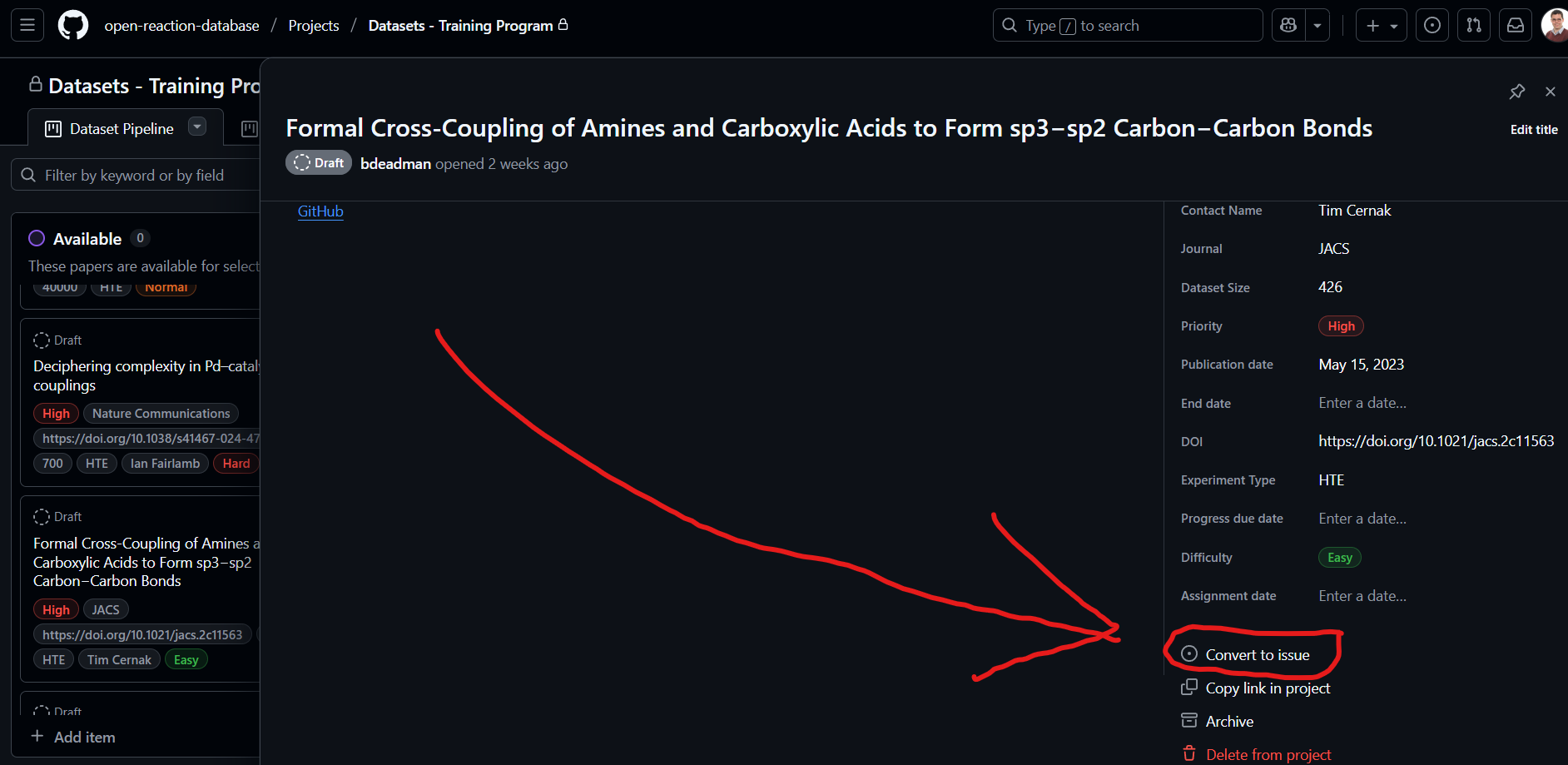
To attract the attention of ORD support you can then tag @bdeadman in an issue comment.
ORD Discord Server#
For a limited time during the 2026 Dataset Rewards program the ORD Program Manager will experiment with providing responsive support through a Discord server. Users can join the Discord Server for free using this link.
In addition to message-based support through Discord, the intention is to organize regular drop-in support sessions where the ORD user community can gather informally to share their dataset preparation challenges, and get support and advice on using the ORD tools. These sessions will be organized and advertized through the Discord server, and their frequency will be scaled to how much demand there is for the sessions.